
Equinox has a built-in Quotation procedure, which results in the generation of a pro-forma invoice. On the Charges tab in the relevant case – you will need to create a case file for the type of work you are quoting for – choose the Quotes option and then click on Create Quote. This will take you to the following screen:
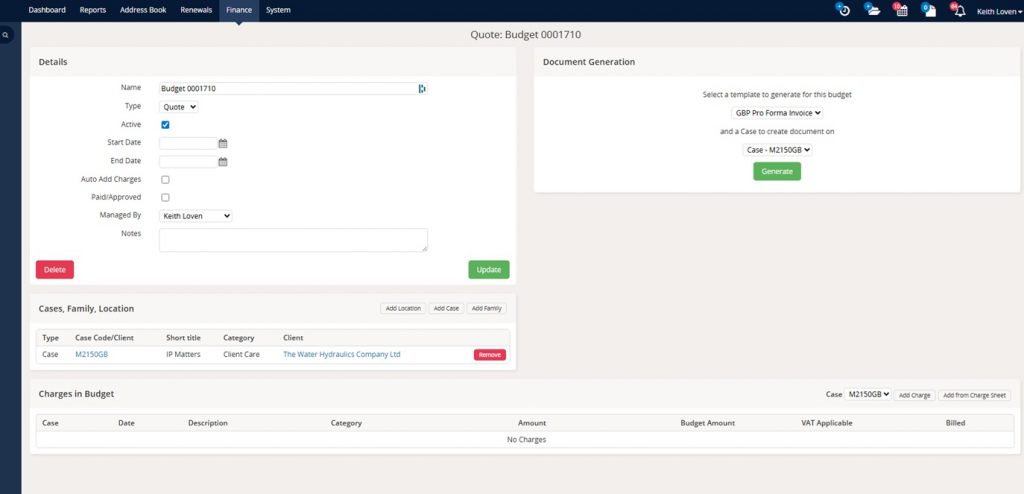
This creates a “Budget” for the work, into which you can add charges manually or from the Charge Sheet as you would in creating an invoice. When you are happy with the charges, you can produce a Pro Forma invoice from this screen – see top RH panel “Generate”. You can set an end to the quotation, rather than making it open-ended. Once you have generated the pro-forma, the charges associated with it are transferred into Charges and can be billed in the usual way.
It is not clear whether this system can be used for quoting for multiple separate cases at the same time, but in the case of renewals for a range of countries, since usual practice is to use just the parent case for simplicity, all the relevant charges can be entered into the one budget.
Note also our policy on generating quotations in respect of instructions received from attorneys from China and Taiwan – see: 3.10 Accepting instructions from foreign attorneys.
So, apart from the renewals situation mentioned above, please do not generate quotations on any file other than the one relating to the work for which you are quoting.
This is very important because when we come to generate an invoice (on a T or P file for example), we will need to make sure that it is consistent with the quoted amount.
Responsibility for the content of any quotation prepared by an administrator lies with the fee earner handling the case, who should therefore always approve it before it is sent out. If the case fee earner is not available, and the quotation cannot be delayed until they return, then it should be checked by another fee earner.
For patent cases to be drafted from scratch, first use the Patent Drafting Cost Estimator. The resulting hours figure can then be entered in the fee calculating spreadsheet, to be found in the Shared Documents folder. Print a copy to pdf and save that to the file. Do not save the spreadsheet. The resulting figures can then be transferred into the Invention Protection Proposal (UKPA120).
Following up after a quotation has been sent
- When quotes have been sent out to a client, it is the fee earner’s responsibility to follow the work up. This should not be delegated to the administrator, because we are keen for the fee earner to foster and develop a close working relationship with each client.
- Follow ups should be done by telephone. Letters or e-mail should only be used as a last resort where telephone contact cannot be made, although obviously they should be used to confirm matters once telephone contact has been made.
- The first telephone call should be made to the client within a couple of days of sending the quote to confirm that the quote was received and to enquire if the client has any further questions.
- If the client has no further questions, we should ask the client if they would now like to proceed. At this point, clients usually either say one of three things:
- “Yes, I’d like to go ahead – I’ll send the money now”. = SALE
- “I need time to think about it/I need to get approval”. = DELAY
- “No, the quote is much more than I was expecting. I cannot afford to proceed/I’ve changed my mind.” = REFUSAL
In the second example, we should try to agree a further follow-up date with the client for as soon as possible so that the enquiry does not go cold. This follow up date needs to be done on a discretionary basis, dependent upon the client’s reason for the delay. If they need to wait for a meeting to get approval, ask when the meeting is and if you can telephone the following day to discuss the decision and answer any questions that may arise out of the meeting. Then set a diary reminder to do so. It is much easier to make contact again if the client is expecting your call.
In the third example, we should try to explore with the client what their cost expectations were. If they suggest that our fees are not competitive, we should reassure them that they are and outline our fixed fee charging policy, with no interim bills, to assist with their budgeting. We should seek to offer solutions to address any concerns that they raise. For example, if they cannot afford it, suggest that they approach organisations such as Business Link to obtain grant funding or offer to stagger the payments, ensuring that we are fully covered in any initial payment for our outgoings and at least some time. Unfortunately, we are no longer able to offer extended terms through Premium Credit. Review the scope of protection that you have quoted for – can this be reduced by a class to cover the bare essentials for the client? (Any sale is better than no sale).
Terms of Business
Sending our Standard Terms of Business
As part of billing and credit control, in particular, we need to be able to demonstrate that we have supplied each client, or potential client, with a copy of our Standard Terms of Business. These terms are to be included within all new quotations – they are generated by clicking on the Terms macro in Word and occupy the final two full pages exactly. Page two of all quotations now contains the wording: “I have read and understood the accompanying Standard Terms of Business and I agree to be bound by them.” We must ask all clients to sign and return the quotation if they wish to proceed with the matter being quoted for.
There are also standard letters available to send out our Terms if needed, or you can send them by e-mail. Any such letter or e-mail should include wording as follows:
“I also enclose a copy of our Standard Terms of Business. Please read them and keep them safe; they form the basis of our working relationship. If you instruct us to act for you, we will assume that you have read and understood them and that you agree that they will apply to the handling of work for you.”
Receiving a signed copy of the quotation
It is clearly always desirable that a copy of the signed Terms are received before we commence work on behalf of a client. If an invoice is unpaid (for example), then it may be much more difficult for us to recover our fees/costs if we can only rely on an implied acceptance of our Terms.
However, there may be circumstances where we have received funds on account from a client, but we have not yet received a signed copy of the Terms. Where this arises, we do not wish to delay matters by refusing to commence work without the signed Terms. In these circumstances, therefore, a fee earner may exercise discretion to proceed with the work without a signed copy of the Terms in the file.
Where we have commenced work without the signed Terms, the fee earner should ensure that the client is reminded to send the signed quotation on to us as soon as possible thereafter. A case should not be simply left to continue on without them. If the client has lost the original copy, we can simply send out a new copy together with reply paid envelope to assist the client in returning the Terms for our records. Do your best to assist the client in letting us have a signed copy of the Terms.
Last Updated on 13 August 2025 by Keith